

How to maximize the gift that is Filipino music, according to Ryan Cayabyab
The National Artist of the Philippines for Music shares his clear vision for a stronger music industry
By September Grace Mahino
July 24, 2025
It has been 55 years since Ryan Cayabyab, a.k.a. Maestro, a.k.a. Mr. C, started his career in music. Yet while he has seen and heard it all, he remains as passionate about it—particularly original Pilipino music (OPM)—as when he was a pianist for a corporate chorale group, working fresh out of high school in 1970.
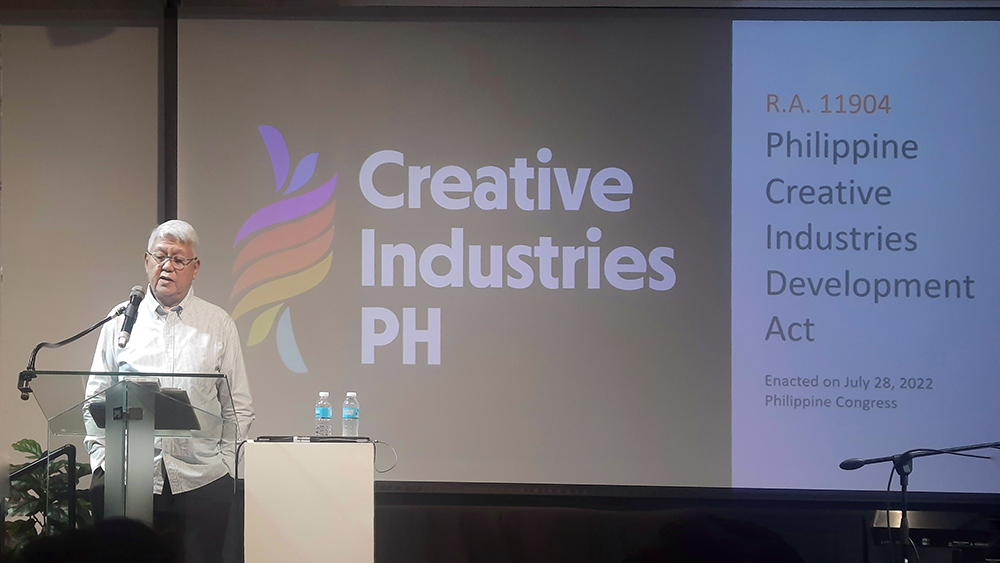
Case in point: While there are people who lament over how a lot of the younger Filipino artists seem to be taking more than just a few notes from Western and K-pop acts, Cayabyab isn’t sweating over it. During his Pamanang Pilipino lecture titled “Enhancing the Power of Music to Tell our Story as Filipinos,” held on June 26 at the Ayala Museum, he advised the audience to basically quit gatekeeping what Filipino music is. “We don’t have to push our young singers and songwriters to learn about Filipino heritage,” he said, “because they’re Filipinos already in the way they are. They just have to be honest [when creating their music].”
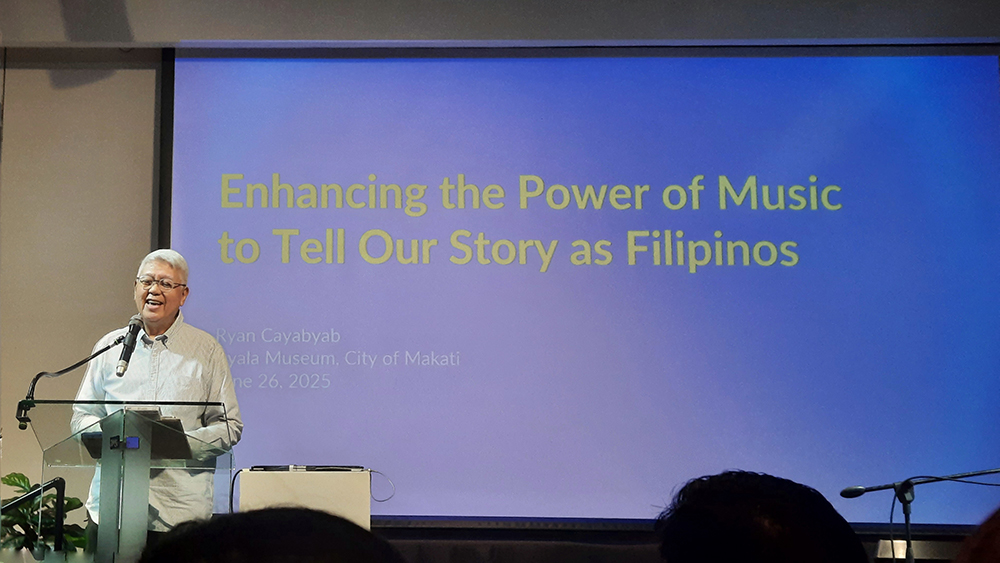
Cayabyab further added that while most artists start out wanting to sound like what’s currently popular, whether it’s RnB, hip-hop, or K-pop, sooner or later, they discover their own sound. “We’re all just using the same music language worldwide: the same core progressions, the same rhythms,” he explained. “But you can’t take away the ‘Filipino’ from the Filipino artist. Even when we’re singing bossa nova or samba, there’s no doubt we still sound Filipino.
“As a storyteller, connector, and influencer, music is a testimony of who we are as Filipinos,” he continued. “It tells us how we live, and continues to do so. It chronicles and narrates how we dreamt, struggled, learned, celebrated, and kept our identity as a nation.”
A natural and gifted storyteller and teacher, Cayabyab also continues to prove his generosity as a creative and a champion of OPM. In his lecture, he shared the four steps that Filipinos—musicians, industry professionals, and music lovers alike—can do to uplift and strengthen Filipino music, not just as a driver of economic growth but also as a chronicler and narrator of the Filipino identity.
1. Study music and then teach it
Some people have a natural talent for music—something Cayabyab calls oido or ear—but knowing and having the right tools to make it is just as critical. “What makes musicians extraordinary is education,” he stressed. “I always advise music camp participants to study music theory and know the basic rules in music-writing because it’s only when you’ve at least learned the rules that you can break them.”
He also encouraged professionals to be mentors and pass on their knowledge to the next generation. “That’s my mantra: Teach everything you know to the next generation so they can be better than us.” For Cayabyab, there’s no such thing as industry secrets to harbor and gatekeep. “The point is [for the youth] to take the knowledge further and become better than whoever taught them those ‘secrets.’” As a lifelong mentor and artist, the Maestro believes the only way for the local music industry to have more extraordinary musicians is to have more teachers guiding the young ones to find their paths and thrive.
2. Keep creating good—and diverse—Filipino music
Crucial to composing and writing music that’s not only creative but also globally competitive is appreciating OPM and the different facets of the culture that spur it. “For it to fly, Filipino music must reflect who we are,” Cayabyab said. Hence, his belief that young artists can create good OPM based on their own perspectives without having to conform to traditional notions of what Filipino music is.
His view is backed by a 2024 research done by the Filipino Society of Composers, Authors and Publishers, Inc. (FILSCAP), which showed that 80% of the popular music listened to by the general Filipino public through broadcast channels is made by local artists. (This is also a trend that CHEKE music label CEO and CREATEPhilippines’ featured creative for June, Justin Weineke, has observed). “During my time in the ‘70s, 85% of the share went to foreign [music],” Cayabyab recalled. “So we’re almost closing the gap, and I don’t think this trend will be reversed in my lifetime. I’m optimistic that we’re on our way toward reaching a 50:50 share.”
He credits the new generation of pop artists for this development, revealing, “I’m a big fan of SB19. Ang galing nila: The discipline is there, the intent, the earnestness. It’s not about being Filipino; it’s about excellence. They don’t have to say they’re Filipino, because with how well they’re performing, they’re already carrying our flag.”
From the profound to the mundane, the collective Filipino experience has been a goldmine of ideas for storytelling through music for Mr. C. “We are a nation of more than a hundred million people; we have different stories to tell.” Indeed, although some of his most popular works involve romantic themes, there was a period when he deliberately veered from writing love songs to composing pieces that reflect other parts of Filipino reality. Just a few of them are “Tsismis,” an a cappella piece that layers Cayabyab’s vocals to create a melodious cacophony of Tagalog gossip catchphrases; and “Limang Dipang Tao,” which chronicled the experience of scrambling for a seat on the commute home.
He also believes that the Philippines’ ethnolinguistic diversity is a strength that is yet to be maximized. Thus, he encourages everyone to dive into regional music. “I tell you, open your ears. There is more music coming from the provinces that are actually so beautiful.” Cayabyab cited a 2012 study that revealed how the world’s current music has become increasingly homogeneous since the ‘50s in terms of timbre, pitch, and loudness. “But when you use a specific language, it’ll have a certain lilt and inflection. That’s why the Visayans and the Ilocanos have different melodies [to their respective music],” he said. “Their use of their local language makes their sound unique. So why don’t we continue to experiment on the sounds, rhythms, and beats of our indigenous tribes, as well as the urban and rural communities from across the regions?” Making OPM diverse—linguistically and thematically—can only strengthen the local music industry. “It’s already happening, but we can do more.”
3. Harness technology to build an audience
Make good music, and the people will listen. But Cayabyab advises musicians to understand the audience they want to build: How does their market define quality music and performances? What will make them buy Filipino instead of foreign songs? And how can we, as a whole, improve the promotion of Filipino music?
Technology has certainly democratized the way artists create and share their work, and it has also made connecting with the audience easier. A downside, however, is that digital music hasn’t resulted in increased income for artists. On top of the paltry payout that streaming platforms give to artists, the 2024 FILSCAP study also showed that 69% of digital music Filipinos listen to is from foreign acts and only 31% is from local ones.
Instead of treating them only as a way to promote music, Cayabyab sees streaming platforms and social media as tools for answering the questions that could point the way toward building a bigger audience for Filipino music. “We can use them to better understand the listening public, engage with them, and convince them to patronize our own.”
4. Support the people who make the music industry possible
A cause close to Cayabyab’s heart is the financial security of music artists. “We must support the people who make this industry possible,” he exhorted the lecture audience. “We can only expect our industry to soar and make a positive impact if we help strengthen the people behind it.”
Citing a survey conducted during the pandemic by Sandy Chua, a musicologist and the dean of the University of Santo Tomas Conservatory of Music, Cayabyab shared that 62% of Filipino musicians who participated in the study earned an average income of less than Php20,000 a month pre-pandemic; that percentage increased to 77% in the midst of the global health crisis. “I don’t know what the numbers are now, but Php20,000 is certainly not enough to sustain a family, what more addressing emergencies such as illness or accidents.”
He knows of what he speaks: Before achieving recognition and success, Cayabyab himself experienced the difficulties of pursuing a music career, both firsthand and secondhand. His mother Celerina expressed her wish before her death that none of her children pursue a music career, based on the hardships she had faced as an opera singer; Cayabyab was only six at the time. Then, when he was already a professional musician, he self-funded the production of an album (and worked as its sole arranger and singer) that was meant to be his swan song in the music industry before a planned shift to teaching. That album is One, released in 1981, and it includes the classic hit “Kay Ganda Ng Ating Musika.”
Although Cayabyab sees the passage of the Philippine Creative Industries Development Act (PCID) into law in 2022 as a welcome development, there is still a lot of catching up to do to make local creative industries a stable and secure source of income for Filipino artists. He’s hopeful, though, that the increasing appreciation for OPM among Filipinos signals a growing recognition of what a robust music industry can do for the country. He’s also optimistic that it will lead to more OPM albums getting bought and streamed digitally than foreign ones, and to more people watching events and concerts by local acts.
“Music is meant to be shared. It grows richer when given and passed on, not kept,” Cayabyab expressed. “Hence, I call on Filipinos to enhance the power of music, to tell our stories by getting more people to listen to it. Let’s show our appreciation for OPM and boost its potential by relentlessly championing it.”
***
Want to promote your events on CREATEPhilippines? Register and have them included in our Calendar of Events. Join our Viber community, too, and follow us on Instagram, Facebook, X, and LinkedIn to be updated on the creative events that we’re promoting.