
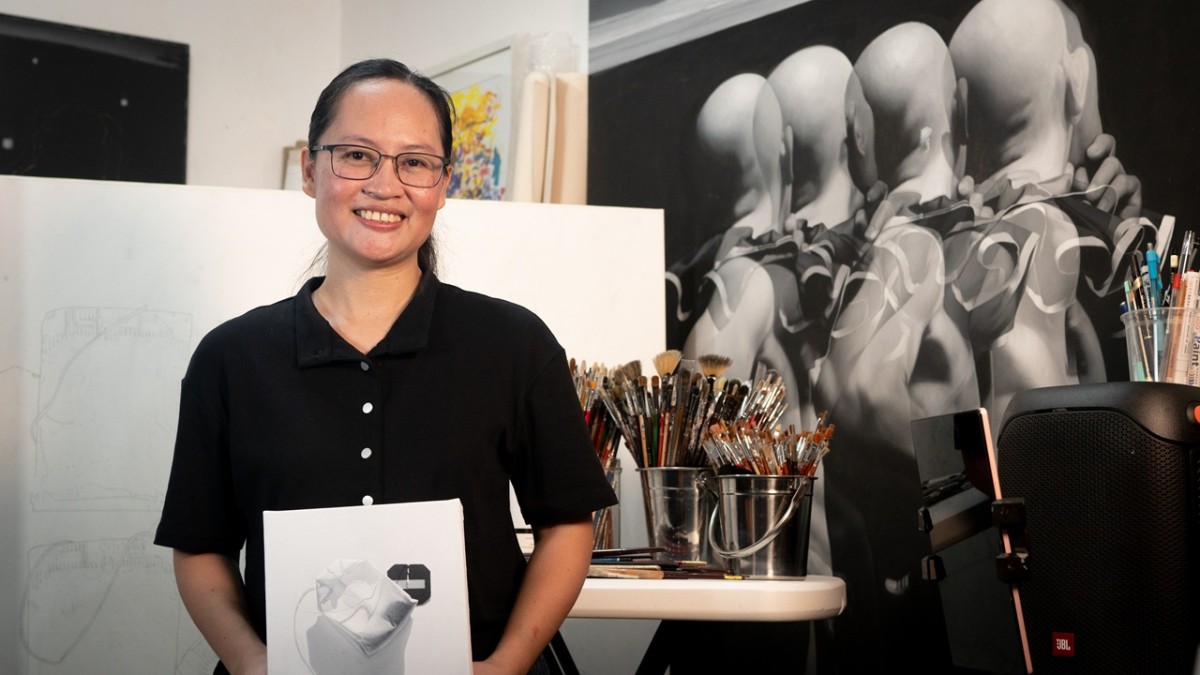
Finding refuge in Marrie Saplad’s art
The visual artist wants her hyperrealistic works to be an anchoring source of calmness and hope
By September Grace Mahino
September 08, 2025
It was a rainy afternoon when CREATEPhilippines visited visual artist Marrie Saplad’s studio, which she shares with her husband, Florante “Pongbayog” Paghari-on, in Muntinlupa. The walls of the cozy space were covered with huge canvases of their works in various stages of progress, along with framed drawings and scribbles by their daughters Daphne and Celestine—proof that art is pretty much a family activity in their household.
“Our routine is, Pong works on his paintings at night while I do mine usually during the day,” Saplad says. “When I wake up in the morning, I do everything for the kids first. Once I’m done with my chores, that’s when I sit down to paint.” Being a full-time mother as well, she has seen to it that her youngest still gets to spend time with her and her husband, even while they’re painting. “She has become familiar with our routine since we’d also give her paper and non-toxic coloring materials to play with. It has become her play time, too, so we could create art while keeping an eye on her.”

Saplad is often introduced as a self-instructed artist, and she credits Paghari-on for being a “strict” but generous mentor. She says that when it comes to talking about art and critiquing her work, they take on a teacher-student dynamic that’s very different from how they are as husband and wife and co-parents. “In the beginning, I’d get angry over how strict he was,” she admits. “But later on, I realized that he was correct in his approach; I wouldn’t have learned had he babied me. I wouldn’t have learned to accept my mistakes and find a way to fix them.”
It’s a tough learning curve that has been well worth it. Saplad has been making a name for herself in the local and international art scenes for the past 8 years with her hyperrealistic and monochromatic paintings that feature everyday household items: glass, hankies, teabags. Clean and deceptively simple, her paintings belie Saplad’s keen observational eye that can track how sunlight filters through a transparent surface, how shadows dapple the weave of a piece of cloth. These same details capture a viewer’s fascination, their gaze following Saplad’s lines in an almost meditative movement.
View this post on Instagram
She’ll be bringing her distinctive style of elevating commonplace items into artworks worthy of reflection to the Focus Art Fair in London in October at the Saatchi Gallery. Saplad is one of the roster of Filipino artists who will be represented in the event, which connects emerging and established contemporary artists from across Asia with global audiences. (Paghari-on will also have his works on exhibit at the art fair.)
“I usually paint singular objects, but for Focus, I’m presenting multiple subjects in a canvas,” she shares. Her idea is to show viewers how seemingly identical objects—a tableau of teabags, for example, Saplad’s subject of choice as of late—still have their own beauty. “Just like how people may have some commonality yet still have their respective experiences. We can’t simply compare each other and ourselves because we each have our own capabilities.”
View this post on Instagram
As Saplad finishes the works she’ll be showcasing in London, CREATEPhilippines gets her to reveal the draw of everyday objects to her, what having an artist as a partner is like, and the driving force behind her art.
The typical track that aspiring artists take is going to art school, then maybe becoming an apprentice to someone established. Does being a self-instructed one make you feel self-conscious or insecure when meeting those who finished art school, or is it actually a point of pride for you?
It’s not really a concern for me. It’s a big deal that I got the opportunity to be an artist at my age, and as a mother of two who didn’t have any formal art education. That just shows how someone’s age and status shouldn’t be limiting factors in pursuing what they want to do.

Of course, it would be really nice to be able to go to school, though—to really be just a student. If you’re in a school, you have the opportunity to mingle with other students learning other art disciplines and share ideas with them, even try different media. Pong and I are focused on making oil paintings because we have responsibilities as parents. We have bills to pay, kids to look after, so even if I’d like to explore what I can do with different art materials, I’d have to consider if buying them would fit in with our budget. The family is always the main priority.
That’s why I’d advise young people to pursue an art education if they can. It would be nice to try out different media and styles and discover what really works for you, without the burden of responsibilities.
It has been 8 years since your first exhibit. Is your relationship with your husband more on an equal footing now when it comes to art, since you’ve also established a name for yourself?
We are a team when discussing art ideas. “Is this good?” “Is this right?” But I can’t fully take out the mentor-student aspect of our relationship because I have such a high regard for his opinions. He has been an artist longer than I have. Until now, unless Pong gives his approval, I won’t be convinced that the work I’ve done is good.

We do give each other advice as artists. The way I give my input on his work, though, comes with an explanation of my opinion. “To me, Pa, this is how it should be done. What do you think?” I don’t just say that I like or dislike something; I also offer my ideas. “Pa, there’s something lacking in this part; you have to make it darker.” I’m happy when he creates good art. That’s how we work as a team.
What is a household run by two artists like, by the way?
Our routine has Pong usually working on his art at night, so he goes to sleep when I wake up in the morning. In case I wake up late, he’d do the cooking and look after the kids until I get up, then he’d go to sleep. We fill in when the other one is busy or tired. It’s also good that our eldest can look after her younger sister, because I know I can rely on her in case I get tired. If I need to do a grocery run but I also have a show deadline to catch, Pong would do the shopping; he’ll just give a call if he has questions about the shopping list. That’s how we basically do time management as artists and parents.
Among the many household items to paint, what draws you to the subjects you choose?
They all have a connection to me. For example, with the glass series, I was attracted to drawing [drinking] glasses because I like their characteristics. I see something of me in them, specifically how transparent I am. In our family, I value transparency; we should be able to say what we feel. I don’t like it when people have a hidden agenda. I prefer them to be frank because, at least, I’d know how to deal with them.
View this post on Instagram
There’s also the idea that each glass has its own beauty. There are those that I just find beautiful. It’s hard to explain…it’s like they have their own inner landscapes that they reveal once you really look at them. They’re not just transparent. That’s why I have my favorites.
View this post on Instagram
With the hanky series…I can’t leave the house without carrying one. I also like the white ones because they just look so clean. I like that sense of purity and freshness in them. Those are what I look for when I meet or negotiate with someone: That what happens after is whatever we had agreed upon. No hidden motives, just pure and clear intentions.
View this post on Instagram
Recently, I’ve been painting teabags because we like drinking tea in the family; it’s just a nice ritual to do together. Whenever Pong goes somewhere, I ask him to look for local teas. I also like the texture of the teabags and how they each have their unique creases. No two teabags are folded in the exact same way, which reminds me of how people are. We may seem alike at first glance, but we have our respective burdens, failures, and experiences. And just as having these creases in the bag doesn’t change the tea’s flavor, failures don’t make any of us less, either. We don’t really know what someone else is going through, what they’re enduring in private, so we can’t judge them or their life based on appearances alone.

Ultimately, what do you want viewers to experience when looking at your paintings?
I’d like people to feel calm when looking at my work—to feel lighter. I want them to find the chance to just relax while viewing my paintings, no matter how chaotic their environment is. When a person is calm, they get a clearer, better perspective on life, regardless of their circumstances. They might even realize there’s a reason why they’re in that situation. They just need faith, plus the space to relax and think. I want my artworks to offer them that space.
***
Learn more about Marrie Saplad on her Directory Profile and follow her on Instagram. Banner image by Camille Dellosa.
Want to connect with Marrie? Get in touch by filling out the Connect with a Creative form. Want to be part of our creative community and have the chance to be featured on CREATEPhilippines? Sign up and register for our Directory of Creatives here. Join our Viber community, too, and follow us on Instagram, Facebook, X, and LinkedIn to be updated on the creative events that we’re promoting.